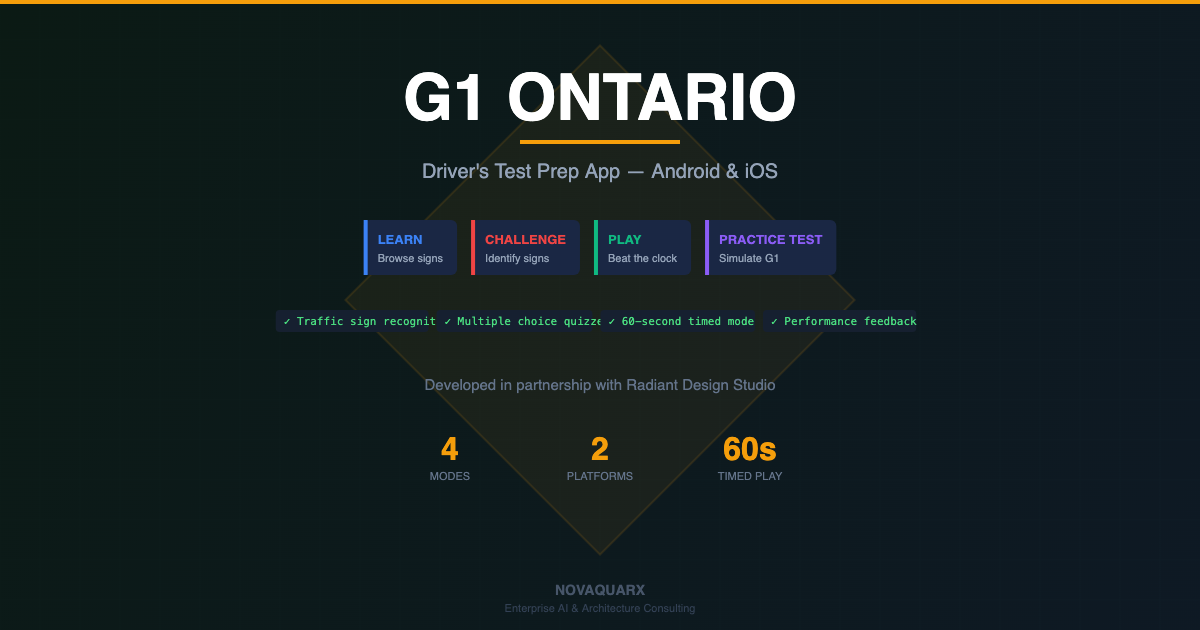
NovaQuarx partnered with Radiant Design Studio to develop G1 Ontario — a cross-platform mobile application designed to help Ontario residents prepare for the G1 written knowledge test. Built for both Android and iOS, the app delivers an engaging, multi-mode study experience that turns road sign memorization into an interactive learning journey.
The Opportunity
The Ontario G1 written knowledge test is a mandatory requirement for every new driver in the province, covering traffic signs, road rules, and safe driving practices. Traditional study methods relied on printed handbooks — static, unengaging, and offering no way to measure readiness. There was a clear opportunity for a mobile-first solution that could make test preparation interactive, trackable, and accessible anywhere.
What NovaQuarx Delivered
The G1 Ontario app was architected around four distinct learning modes, each designed to build knowledge progressively — from passive review through active recall to timed performance under pressure. The app was built to be phone and tablet compatible across Android devices, with content structured for easy updates to signs, questions, and imagery.
Learn Mode — A guided walkthrough of Ontario traffic signs. Users browse through the complete catalogue of signs at their own pace, with each sign displayed alongside its description and a contextual background. Previous and Next navigation lets users move freely through the sign library, building foundational knowledge before moving to interactive modes.
Challenge Mode — An active identification exercise where users are presented with a traffic sign and four possible descriptions. Selecting the correct answer highlights it in green and adds a point; selecting incorrectly highlights the wrong answer in red and reveals the correct one. At the end, a detailed assessment shows the user’s score, personalized feedback based on performance tiers, and a scrollable review of every sign they got wrong — reinforcing learning through immediate correction.
Play Mode — A fast-paced, timed challenge with a 60-second countdown. Users identify as many traffic signs as possible before the timer runs out, with a conveyor-belt animation showing upcoming signs queued to the right of the current one. The mode tracks high scores across sessions, creating replayability and a competitive element. Performance feedback adapts based on the score achieved, with special recognition for beating the stored high score.
G1 Practice Test — A simulation of the actual G1 written test experience. Users answer multiple-choice questions covering both traffic sign identification and road rules, with randomized question order and shuffled answer positions. The format mirrors the real test centre experience — question-by-question progression with a Next button to confirm each answer — giving users realistic practice before their test day.
Built for the Real World
The app was engineered with a content-driven architecture that separates sign data, questions, and media from the application logic. All content — traffic sign images, descriptions, quiz answers, background assets, and feedback text — is managed through an external configuration file, allowing the client to update the sign library, add new questions, or adjust scoring thresholds without requiring code changes or a new app release.
Social sharing was integrated into both Challenge and Play assessment screens, enabling users to post their scores directly to Facebook and Twitter — driving organic awareness among the exact demographic most likely to need the app. Audio throughout the application — background music per mode, sound effects for interactions — added polish that elevated the experience beyond a simple quiz tool.
The assessment system delivers tiered, performance-based feedback across all modes, with distinct messaging for scores below 50%, between 50–75%, between 75–100%, and perfect scores. This feedback loop encourages repeated play and progressive mastery rather than a single pass-fail outcome.
Why It Matters
G1 Ontario demonstrated NovaQuarx’s capability in consumer mobile application development — delivering a polished, multi-mode educational product in partnership with a design studio. The project required balancing engaging game mechanics with educational rigour, building a content architecture flexible enough for ongoing updates, and delivering a cross-platform experience that worked seamlessly on both phones and tablets.
The same principles — content-driven architecture, progressive learning design, performance tracking, and social engagement — apply to any organization building mobile learning, training, or assessment tools.
Building a mobile learning or assessment application? Start a conversation with NovaQuarx.
Frequently Asked Questions
What is G1 Ontario?
G1 Ontario is a mobile application developed by NovaQuarx in partnership with Radiant Design Studio to help Ontario residents prepare for the G1 written knowledge test. It features four interactive learning modes — Learn, Challenge, Play, and Practice Test — covering traffic sign recognition and road rules.
What platforms does G1 Ontario support?
G1 Ontario was built for Android (phone and tablet compatible) and iOS, delivering a consistent learning experience across device types and screen sizes.
Does NovaQuarx build mobile learning and training applications?
Yes. NovaQuarx has experience delivering mobile applications that combine educational content, interactive assessment, performance tracking, and social engagement. The content-driven architecture used in G1 Ontario allows ongoing updates without code changes — a pattern applicable to corporate training, compliance testing, and certification preparation. Contact us to discuss your project.